


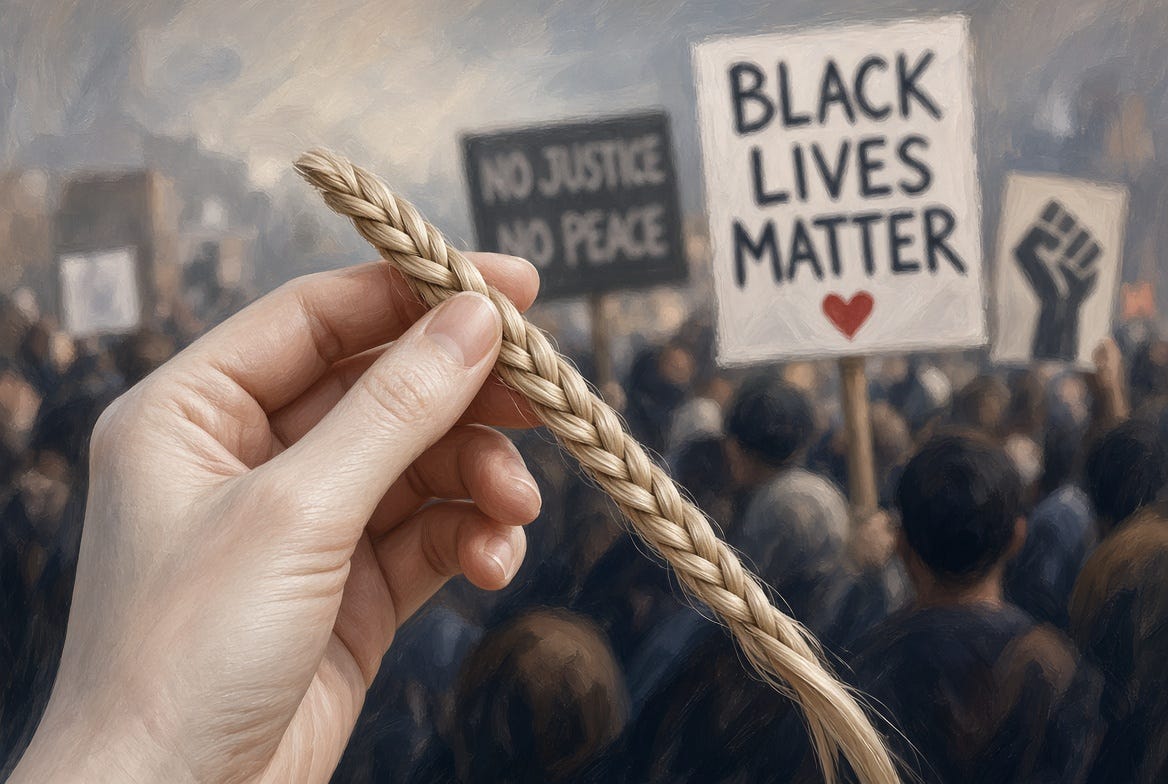
The CROWN Act was one of the many ridiculous spinoffs of the BLM era. Around half of the states in the country have since passed a “Creating a Respectful and Open World for Natural Hair” (CROWN Act) protecting black people from supposed discrimination over their hairstyles.
But in another example of the law of unintended consequences, the CROWN Act may be about to get a real workout from a white woman who was fired for wearing a black hairstyle.
In September, the Baltimore Rock Opera Society announced that it was hiring Kelly Carnes as its executive director, citing her 21 years of experience and her work with the Smithsonian and the Kennedy Center. In the publicity photo, Carnes appeared to have some sort of Cruella de Vil hairstyle in which one side of her hair is black and the other is white, possibly foreshadowing the racial hair drama soon to get her fired and become a national news story.
Since the Baltimore Rock Opera Society puts on cheesy rock theater productions, this shouldn’t have been a problem, but then Carnes went to Burning Man and decided to style her hair in braids to keep the dust out in the desert air. Members of BROS, who are mostly white, were offended by the braids, which they considered to be cornrows, a black hairstyle.
1 in 5 people in Baltimore are living in poverty. Less than a third of high schoolers can read at grade level. Chances of being a victim of a violent crime are 1 in 62 and chances of becoming a victim of a property crime are 1 in 24. Also, the city is so overrun by rats that the Norway rat is its unofficial mascot. A white lady in a hairstyle, some argue are just Dutch braids and others claim are cornrows, would seem to be a fairly low priority for Baltimore. But not for the Wokes.
While black people can use white hairstyles, white people using black hairstyles is considered to be ‘cultural appropriation’ and a crime just short of calling the police or asking to speak with the manager. The Baltimore Rock Opera Society, which is reportedly on the verge of bankruptcy, posted an Instagram message stating, “we have received many heartfelt and concerned messages from members of our community regarding a video circulated on social media showing our new Executive Director, who is white, wearing cornrows at a recent BROS public event. We share the weight of these concerns and take this matter seriously, and the Board has been in continuous conversation about them since Monday morning.”
Carnes was told to write an apology letter and forced to resign; she is considering a lawsuit under the CROWN Act which could well be enough to finish off the struggling organization.
But the organization, which has been operating in a net negative income, is mostly run by volunteers and its board members are resigning, promised to form a “working group for Culture, Community Voice, and Racial Equity (working title)” to boost DEI at the mostly white group, and announced that it was going to revise its “Anti-Discrimination Policy to more clearly address cultural representation and dress” to discriminate against its new employee’s hairstyle.
The wording implied that the Rock Opera Society had spell out to write anti-discrimination policies that prohibited people of certain races from wearing particular hairstyles. None of the establishments targeted by CROWN Act enforcement had ever done such a thing or would have contemplated doing such a thing as specifying that black employees can’t wear their hair in braids. It took woke discrimination to set out which races can wear their hair in which way.
The Rock Opera Society might not survive long enough to be sued, and it may not have enough paid employees to be successfully sued, but the case could serve as a test for the CROWN Act.
Maryland’s CROWN Act followed the usual template in many states of classifying hairstyles as a characteristic of race. Fire someone for having a messy or ugly hairstyle and you would be guilty of racial discrimination. But apart from a brief mention of “Afro Hairstyles”, the CROWN Act makes no mention of which specific race is being discriminated against and it does focus on “protective hairstyles” which are defined as a “hairstyle designed to protect the ends of the hair by decreasing tangling, shedding, and breakage, including braids, twists, and locks.”
Can a white woman be protected from being discriminated against over her hairstyle because of her race? The CROWN Act was calculatedly written to protect only one racial group’s hairstyles, but the legislators behind it never expected to deal with a racial hairstyle discrimination situation in which the fundamental problem was that hair was not attached to race, but detached from it.
And if the CROWN Act doesn’t protect her, then the law itself is inherently discriminatory.
Firing people for having the wrong kind of hairstyle is not inherently discriminatory. Restaurants might have rejected workers who had messy hair that was difficult to keep clean. Fashion boutiques might have turned down store employees whose hairstyles just looked ugly.
The CROWN Act treated these as forms of racial discrimination when they weren’t.
However, classifying hairstyles as inherently racial, which the CROWN Act does, and then firing an employee for wearing a hairstyle that they believe is incompatible with her race is the literal definition of racial discrimination. And the Baltimore Rock Opera Society allegedly not only did so, but apparently set out to write a policy banning people of certain races from wearing certain hairstyles. If the CROWN Act can’t protect against that, then it represents systemic racism.
And that is the larger issue with the CROWN Act and a good deal of other woke era legislation that purports to protect civil rights while actually creating racial entitlements and violating civil rights because they’re rooted in the misguided notion that discrimination is a form of power and that oppressed people can’t have power and cannot discriminate, only be discriminated against.
This leads to permitted and prohibited categories of racial discrimination where firing a black employee over her hairstyle is racism while firing a white employee over her hairstyle is social justice even though the former is at worst unconscious discrimination while the latter is consciously intentional discrimination. In the process of remedying a discrimination that doesn’t exist, new forms of discrimination are created that did not previously exist.
Equity, one of the disastrous DEI principles that the Baltimore Rock Opera Society committed to in the wake of the braids incident, is not satisfied with ending actual discrimination, but invents new discriminatory structures to create a two-tier justice system. New forms of increasingly imaginary forms of ‘systemic racism’ are identified and countered with punitive forms of actual systemic racism meant to punish and disempower white people.
But, as in the Baltimore Rock Opera Society case, quite often it becomes white people punishing other white people for failing a political purity test that black people don’t care about.
Woke civil rights legislation just strengthens the ability of white radicals to purge other white people for perceived slights towards minority groups. This isn’t remedying racism, it’s a totalitarian movement enforcing party discipline over trivial things. Baltimore’s black population has a lot of problems. A white woman in braids isn’t one of them.
This article previously appeared at the Center’s Front Page Magazine.
And click here to support my work with a donation.
Thank you for reading.

Read my book ‘Domestic Enemies: The Founding Fathers’ Fight Against the Left’ to discover the true origins of the American Left.
So glad to be retired and not have to put up with nonsense.
“, it’s a totalitarian movement enforcing party discipline over trivial things.” 100% correct