


At its 2025 convention, the Democratic Socialists of America removed a clause allowing for the expulsion of members “under the discipline of any self-defined democratic-centralist organization”. This echoed a foundational moment in the history of the SDS, one of the DSA’s predecessors, when it removed its anti-Communist clause at its 1965 national convention.
Communists, including the Maoists of the Progressive Labor Party (PLP), soon poured into the SDS. By the 1969 convention, the Students for a Democratic Society (SDS) managed to oust the PLP, not because it was Communist, but because it was so Communist that it was technically anti-Communist as the “PLP attacked Ho Chi Minh, the NLF, the revolutionary government of Cuba -all leaders of the people’s struggles for freedom against U.S. imperialism.”
Four years after tossing aside the exclusion clause, the SDS had been reduced to infighting between different Communist factions over which of them were the bigger Communists. The PLP lost the fight and the domestic terrorist organization known as the ‘Weather Underground’ emerged triumphantly in charge of the SDS and began planting bombs to overthrow America.
The 1969 convention would also prove instrumental in the emergence of the Democratic Socialists of America which had its roots in this chaotic era. Elements of the SDS, some associated with Communists, worked to build alternative organizations including one that would come to be called the The New American Movement (NAM). The NAM was interlaced with The New Communist Movement, took part in New Communist Movement events, featured Communist leaders and included a Marxist-Leninist Caucus inside its organization.
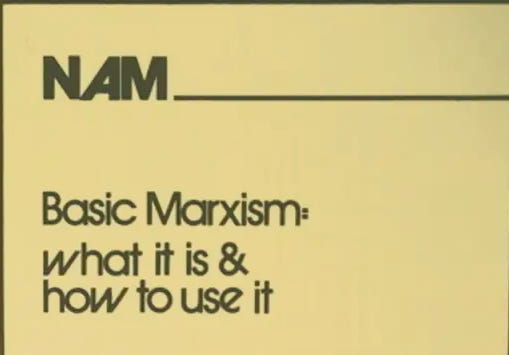
NAM’s official magazine, ‘Moving On’, guardedly stated only that “the New American Movement combines a Marxist analysis with careful attention to the current realities of American politics,” but NAM’s political text, ‘Basic Marxism: What It Is & How to Use It’ included writings from not only Karl Marx, but Lenin and Gramsci, signaling the group’s revolutionary Communist bent.
