


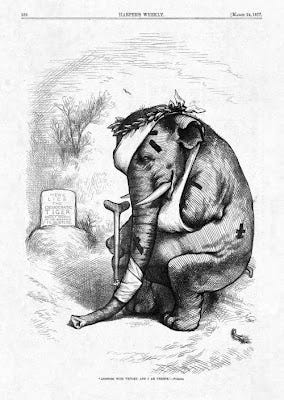
The first step toward understanding what went wrong in the 2008 election, beyond the voter fraud and the media's barrage of propaganda, is to address what the GOP should be and what it wasn't.
The Democrats ran the 2008 election on personality and biography, which they could not have done if the Republican party could have credibly laid out an alternative vision for the future. Instead McCain played "Experience" against "Change" and while that might have squeaked him through in an honest election, it was a hopeless charge when confronting the kind of fraud and mass madness the Democrats had thrown into the pot.
But the core failure lies with the unfortunate reality that the Bush era Republican party lacked substantive policy differences with the Democratic party. There are of course many ethical, moral and ideological differences, but when it comes to practical politics that isn't enough.
The Republican party ran against big government and yet once in office became the party of big government. The Republican party ran on fiscal conservatism and yet once in office spent like mad, even the NEA swelled under Bush. The Bush Administration made bipartisanship work by handing out pork to everyone who wanted it on both sides of the aisle. The size of government has ballooned and so has the deficit.
It was all very well to call Obama a socialist, which he is, when the Bush Administration has been happy enough to run the socialist machine. Obama may implement a far more extreme version of socialism, but such distinctions are easily lost on the general public. Worse yet they smack of hypocrisy.
Opposition to big government is a position that resonates well with the general American public, the public that is too turned off politics to bother showing up at the voting booth, and by their absence made room for the fraudulent ACORN voters to steal the election.
It's not enough to offer the occasional tax rebate. Taxes have to be slashed and burned to both cut the deficit and kill the Federal pork express and the grandiose Federal social welfare programs. It's not enough to talk about the size of government. If the GOP is to get serious, it's time to begin torching the bureaucratic forest. Americans today are more regulated than ever, subject to more paperwork and government restrictions.
While the Democrats, formerly Anti-Federalists, have long since entrenched themselves in the Federal bureaucracy, it is past time for the Republicans to become the Anti-Federalists. It is of course hard to give up power once you've gained it, but weakening the Federal government strengthens states and communities, which are the real power base for Conservatism.
Decentralization weakens the urbanized power bases of the Democratic party. It neuters the bureaucracy on which the party has come to depend on to move its agenda along even when it is in the minority.
For all their "Power to the People" rhetoric, the Democrats depend heavily on an urban base and on the programs they dispense through the Federal government to keep entire populations dependent and ghettoized. Breaking the back of that monster by moving domestic powers away from the Federal government and back to the states means achieving genuine "Power to the People", a prospect that Democrats who despise non-urban populations, fear.

By harnessing the frustrations imposed by government on the ordinary American, the heavy tax burden, the waste, the pork, the Republican party can take back Congress and the White House... but it has to be more than rhetoric. It has to be a real agenda. Under Gingrich, we made some progress. It's time now for a new Contract with America. One that will go much farther.
Reagan's ability to connect with the ordinary American lay in his understanding of the frustrations that most people had toward an impersonal government. There is a lot of talk about Reagan's legacy, but his real legacy should be a Republican party capable of genuine revolutionary action backed by rhetoric devoid of condescension that connects to the experiences and frustrations of the ordinary American. We should not shy away from partisanship or from radical proposals. It is the only way to survive.
Finally Obama's election is a preview of things to come if the immigration problem is not dealt with within the decade. The Democrats want nothing more than a large underclass which has not absorbed American traditions and history and is easily gulled into voting bread and circuses for itself. If we do not drastically slash third world immigration, not only will we face the indigenous Islamic terrorist threat by second generation Muslim immigrants that Europe already faces, but the American electorate will no longer be American.
The American voter whose confidence we need to win is frustrated by illegal immigration, by having to shell out tax dollars for social benefits for immigrants and by the transformation of his towns and communities into something alien to his experience. The Republican party can win big in district after district by taking up his cause. It will however lose big if it panders to the La Raza crowd in the hopes of winning a few thousand Latino voters here and there.
Finally on the War on Terror, the American public is not softhearted. It simply has a limited amount of patience for a war that consists of policing a long drawn out rebuilding process in a foreign country. Americans are prepared to fight ruthlessly against terrorists. They are not prepared to be turned into an endless piggy bank and blood bank for nation building projects.
Finally on abortion, the constant tiptoeing around the issue has not done much to bring over pro-choice swing voters, it has done a lot to make religious conservatives apathetic and unable to distinguish one side from the other except by differences of mere degrees.

The bottom line is that the Republican party will not win pro-choice women over in any significant numbers. It's a dead end because no matter how much a Republican candidate tiptoes around abortion, the rhetoric on the other side nevertheless claims that the moment he's in office it's back to coathangers again. In other words election after election, Republican candidates try to play moderate and get kicked in the teeth by both pro-choice and religious conservative voters. It's pretty clear which one we can win over and which one we can't.
A useful compromise on the issue is once again to kick the matter back to the States. It's blatantly obvious that there is no constitutional right to abortion. But at the same time it's extremely unlikely that abortion can be or should be banned at the Federal level. It's best to simply take the Federal government out of the equation and let voters in each state decide for themselves. This will let Blue States and Red States have it their own way, while drawing the fangs of the radical feminist movement in national elections who will no longer be able to frame elections on abortion as a single issue.
These are my thoughts. You may not agree, but having the discussion itself is a start. The Democrats have demonstrated how much power can be had in harnessing online voices. It's past time the Republican party took them seriously as well.
