


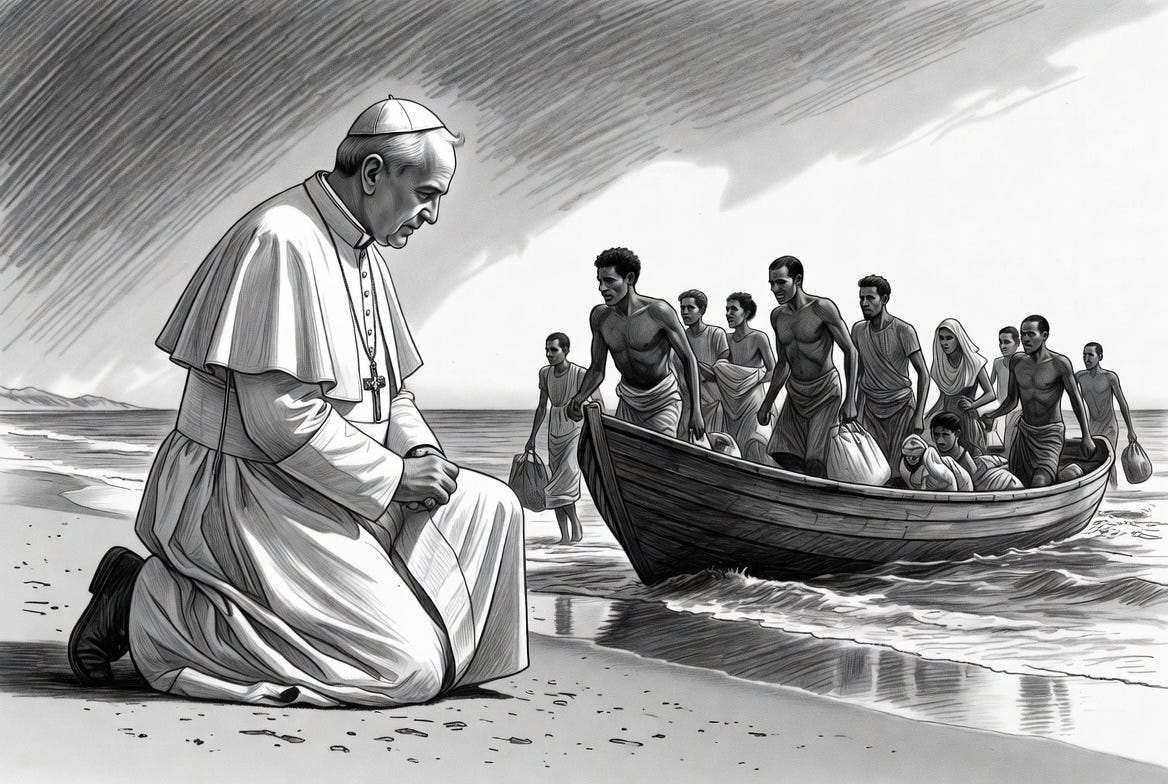
Pope Leo XIV, the first American born pope, will not celebrate July 4th in America, but will instead continue his trip to promote mass migration to Europe and will accept the Liberty Medal over Zoom from the National Constitution Center (past recipients include Hillary Clinton, Jimmy Carter and Vladimir Zelensky) while on the Muslim migrant overrun Italian island of Lampedusa.
The timing is no accident. Neither is the pope’s current trip to Spain to prop up its corrupt leftist government, much of which is facing potential prison time after a series of police raids and investigations, to protect its globalist project of opening up Spain to mass migration.
“Dear migrants, before saying anything else to you, I want to bow before your dignity,” Pope Leo told the invaders who had overrun Spain’s formerly placid Canary Islands.
“Human dignity has no passport,” he insisted, a sentiment more fit for a John Lennon song than the pontiff of a church that would not exist but for a Christendom built on nations with borders and passports. But a day earlier, the pope had also insisted that “we cannot believe in Jesus and promote war” a sentiment not only foreign to the Catholic Church for the vast majority of its history, but which would have ensured the fall of Vienna and Europe to Islamic invaders.
And Rome would then have become one with Byzantium leaving the church a tiny remnant.
But at the docks of Arguineguín, a Canary Islands port that witnessed Muslim migrant mass invasions so severe that over 1,000 invaders entered in only 3 days in 2024 and on some high points in earlier years as many as 1,000 had invaded in only a single day quickly overwhelming the resources of Gran Canaria where the economy is heavily dependent on tourism.
The inability of the poor island to adequately house the invasion attracted parasitic NGOs who blasted it as the “port of shame” and organized boat pickups of invading migrants and rallies to protest because the migrants did not have the kind of ideal accommodations they deserved.
Pope Leo echoed that message, arguing that the “drama of migration” was “an appeal to the conscience of Europe, which cannot claim to uphold human dignity” and which he contended was defined by, among other things, “legal and safe pathways” to invade Europe.
“Today, here by the sea, every individual that arrives asks us what remains of our humanity,” he castigated an island that had already suffered so much at their hands. “Sooner or later, it will be known whether we protected life or whether we yielded to indifference.”
One woman at least had taken that message, the same one put out by Pope Francis, to heart.
We don’t know her name, but we do know that the Irish woman saw four Muslim migrants camping out in a city park twenty miles from where the pope is now making his appearance. It was at the height of the mass invasion of the island and she asked if she could help them with anything.
And in response they attacked her and gang raped her.
One of the Muslim rapists had previously been arrested in the area for another sexual assault before being released. Such stories have become all too commonplace in the Canary Islands where a Danish tourist was raped by 4 Moroccan Muslims, before managing to fight off the fifth man, the media noted tha there were already 16,000 Moroccans living on the Canary islands.
But the difference is that the woman had been doing what progressive politicians and clerics had been telling her to do, to show concern and to avoid indifference at the plight of migrants.
And was gang raped by them for it in a painfully apt metaphor for what is happening in Europe.
Pope Leo had no words to spare for that woman and her “human dignity” or for any others who had suffered from the mass invasion of an island, a nation and a continent by a hostile culture and religion.
The invasion, he argued, “asks us if we have recognised Christ in those who disembark.” Or perhaps, somewhat more likely, Mohammed, who also began his invasions with rape, robbery and murder. But a better question still might be whether he sees a future for Christianity in a Europe that opens its doors and its ports to Islamic mass migration.
Since the Islamic Federation of the Canary Islands was established in 2015, it now claims to have 40 mosques headquartered, ironically, in Los Cristianos. Spain now has some 2,000 mosques that grow even as the share of Catholic churches continues to decline.
Only a minority of Spanish people 18-29 describe themselves as Catholic in what was once one of the most Catholic countries in the world. There are 2.5 million Muslim settlers in Spain and in some areas like Catalonia, their numbers are approaching 10% of the population.
“From this island, I would like the voices of those who spoke today to reach those who hold significant positions of responsibility — civil authorities, parliaments, governments and international organizations — as well as Christian communities… every boat that arrives brings a question along with the migrants: what kind of world have we built?” Pope Leo asked in his address at Arguineguín.
That is a good question. And one worth asking, not with the globalist facetiousness that treats all local crises as global ones and asks us all to take responsibility for the world, rather than for our countries and our families, but that asks what kind of future has been built for Christianity and the Catholic Church in Spain?
And across Europe.
When the leader of the Catholic Church prioritizes the mass migration of Islam to Europe rather than building up Christianity even in the face of the prospect of the church becoming a minority religion, what is really being built and what is really being lost? When that same leader skips the July 4th celebrations in America, a country where the Catholic Church’s survival depends on beating the cultural odds, and instead stumps for Muslim migrants invading Italy, what is that?
We should indeed all ask ourselves what kind of world and what kinds of nations we want.
Is it one where well-meaning women are gang-raped and then forgotten again because they have been taught that helping Muslim migrants is more important than keeping themselves, their families, and their countries safe? Is it a world where western civilization has a future?
Or is it Gran Canaria, Lampedusa and the other shores where the invasion is underway?
Pope Leo says that, “human dignity has no passport,” but without passports and borders there are no nations, no civilizations and no human dignity, just invasions, robbers and rape gangs.
Or, to put it simply, Islam.
Daniel Greenfield is a Shillman Journalism Fellow at the David Horowitz Freedom Center. This article previously appeared at the Center’s Front Page Magazine.
And click here to support my work with a donation.
Thank you for reading.
Read my book ‘Domestic Enemies: The Founding Fathers’ Fight Against the Left’ to discover the true origins of the American Left.
One day, if he lives long enough, a blade will be at his throat and he will deserve what he gets.
The decline of Christianity—particularly in the Western world—is driven by a combination of secularization, the rise of the internet, institutional scandals, and lifestyle shifts. While the number of Christians globally is still growing, Western societies have experienced a major drop in church attendance and religious identification.
The relationship between Islam and Christianity dates to the 7th century, marked by rapid military conquests and the subjugation of Christians. Historically, this dynamic ranged from periods of enforced dhimmitude (second-class status involving special taxes) and sporadic violence, to severe contemporary extremism.
Conquest & Status: As Muslim armies swept through the Middle East, North Africa, and the Iberian Peninsula, ancient Christian centers like Antioch, Alexandria, and Jerusalem fell under Islamic control. Christians were frequently designated as dhimmi—protected but subjugated citizens who retained the right to practice their religion but were forced to pay a special tax called the jizya.
The Pact of Umar:
The early caliphs, such as Umar II, formalized strict social limitations on Christians. These restricted the building of new churches, public displays of the cross, and proselytization.
Martyrs: While early scholars debate the existence of systematic mass persecution by early caliphs, historical records indicate many localized executions for apostasy, blasphemy, and resistance to forced assimilation.
The Millet System: Under the Ottoman Empire, Christians were organized into semi-autonomous millets. While offering some internal legal freedoms, this system solidified their status as unequal subjects.Devshirme System: The Ottomans levied a "blood tax" that required the surrender of Christian male children (mostly in the Balkans) to be converted to Islam and serve in the military or state administration.
Late Decline: The collapse of the Ottoman Empire saw instances of large-scale violence against Christians, notably the Armenian, Assyrian, and Greek genocides during the early 20th century.
Contemporary Persecution and ExtremismIslamic State (ISIS): The 21st century witnessed intense, genocidal violence against Christian minorities in Iraq, Syria, Libya, and Nigeria. Christians were subjected to massacres, sexual slavery, forced conversions, and the systematic destruction of ancient religious sites.
State and Social Harassment:
In several Muslim-majority nations, Christians face systemic pressure. In countries like Iran and Saudi Arabia, strict state controls and blasphemy laws heavily criminalize evangelism. In others, such as Nigeria, Pakistan, and Egypt, Christians often face intense social hostilities and attacks from extremist groups.